On this page
- The Bottom Line
- Key Facts
- 🍑 First: Meet the Family Living Back There
- 🍑 Mystery #1: “But I Squat!”
- 🍑 Mystery #2: You’re Doing the Exercise—but You’re Not Progressing It
- 🍑 Mystery #3: You Think the Hip Thrust Is Just a TikTok Exercise
- 🍑 Mystery #4: Deadlifts Aren’t Useless Either
- 🍑 Mystery #5: You’re Majoring in Donkey Kicks and Minoring in Heavy Stuff
- 🍑 Mystery #6: You Keep Changing Your Workout Every 11 Minutes
- 🍑 Mystery #7: You May Not Be Training Enough—or Recovering Enough
- 🍗 Mystery #8: Baby… Are We Eating?
- 🧬 Mystery #9: Genetics Entered the Chat
- 🍑 So What Should I Actually Do?
- 📈 The Part Nobody Wants to Do: Track Your Training
- 🚨 And Please Stop Falling for These
- 🍑 The Anal Coach’s Bottom Line
- When to Seek Medical Care
- Research & references
The Bottom Line
You squat.
You deadlift.
You kick your leg backward like an angry mule.
You have spent enough time on the hip abduction machine to legally claim it as a dependent.
And yet…
You turn sideways in the mirror and ask the question nobody at the gym wants to admit:
“WHY IS MY ASS STILL FLAT?!”
First, your glutes are not ignoring you out of spite.
Probably.
Building a bigger, stronger, rounder butt is a process called muscular hypertrophy—and simply performing exercises that involve your butt does not guarantee that your glutes are receiving enough of the right stimulus to grow.
So before you add another 200 donkey kicks to tomorrow’s workout, we need to talk about what actually builds a butt.
And yes, science has investigated this.
Key Facts
- Glute growth is muscular hypertrophy — doing an exercise that involves the butt is not the same as giving the glutes enough of the right stimulus.
- A 2025 systematic review and meta-analysis found that resistance training produces meaningful gluteus maximus growth, including from squats and barbell hip thrusts.
- A randomized training study using MRI found hip thrusts and back squats produced similar glute hypertrophy over nine weeks.
- Muscle activation measured by EMG does not automatically predict which exercise grows the most muscle.
- Progression over time — load, reps, sets, range of motion or exercise difficulty — is what keeps the stimulus adequate.
- Protein and adequate total energy matter; additional fat-free-mass benefits appeared to level off around roughly 1.6 g/kg/day in one major meta-analysis.
- Genetics, pelvic structure, muscle attachments and fat distribution influence shape. Training changes size and proportions, not your skeleton.
🍑 First: Meet the Family Living Back There
When we casually say “the glutes,” we’re actually talking about several muscles.
Gluteus maximus
This is the big one.
The gluteus maximus provides much of the muscular size we associate with the butt. It’s heavily involved in hip extension—think standing up from a squat, climbing stairs, sprinting, deadlifting and driving your hips forward.
Gluteus medius
Located more toward the upper and outer portion of the hip, the gluteus medius helps abduct the hip and stabilize the pelvis.
Gluteus minimus
The smallest and deepest of the three. It assists with hip movement and pelvic stability.
Translation:
Building a nice butt isn’t necessarily about finding ONE magical booty exercise.
You’re building a three-dimensional muscular structure.
And unfortunately, Instagram cannot sell you a resistance band that overrides human anatomy.
🍑 Mystery #1: “But I Squat!”
Wonderful.
But doing squats and training squats effectively for hypertrophy are two different things.
A 2025 systematic review and meta-analysis specifically examining gluteus maximus hypertrophy found that resistance training produces meaningful glute growth. Back squats performed to approximately parallel or through a full range of motion were among the exercises shown to increase gluteus maximus size. [1]
And there’s another important piece:
DEPTH MATTERS.
Research examining range of motion suggests that training muscles at longer muscle lengths and through appropriately large ranges of motion can be advantageous for hypertrophy in some contexts. Research specifically examining the gluteus maximus has found greater growth with full-range training than certain shortened partial-range approaches. [3]
That doesn’t mean everybody needs to squat ass-to-grass.
Your anatomy, mobility, training experience and injury history matter.
But if your “squat” consists of unlocking your knees three inches while holding 315 pounds…
Sir.
Your ego may be experiencing hypertrophy.
Your glutes may not be.
🍑 Mystery #2: You’re Doing the Exercise—but You’re Not Progressing It
Here’s one of the biggest problems with booty workouts:
People do the exact same workout…
with the exact same resistance…
for the exact same repetitions…
for six months.
Your body is extremely good at adapting.
For continued muscle development, your training has to provide an adequate and progressively challenging stimulus over time.
That might mean gradually increasing:
- resistance
- repetitions
- sets
- range of motion
- exercise difficulty
- training quality
You don’t have to add 20 pounds every Tuesday.
But there should be some form of progression over time.
A large systematic review and network meta-analysis involving 119 studies examining hypertrophy found that many different resistance-training prescriptions can build muscle. Multiple-set training performed particularly well for hypertrophy, while heavier loads were especially useful for maximizing strength. [4]
And the 2026 American College of Sports Medicine position stand—an overview incorporating 137 systematic reviews and more than 30,000 participants—concluded that progressive resistance training improves muscle size, strength and physical performance. For hypertrophy specifically, higher training volume was one factor associated with greater gains. [5]
Translation:
Your butt needs a reason to change.
If the 20-pound dumbbell stopped challenging you sometime during the Obama administration, we may have located the problem.
🍑 Mystery #3: You Think the Hip Thrust Is Just a TikTok Exercise
Nope.
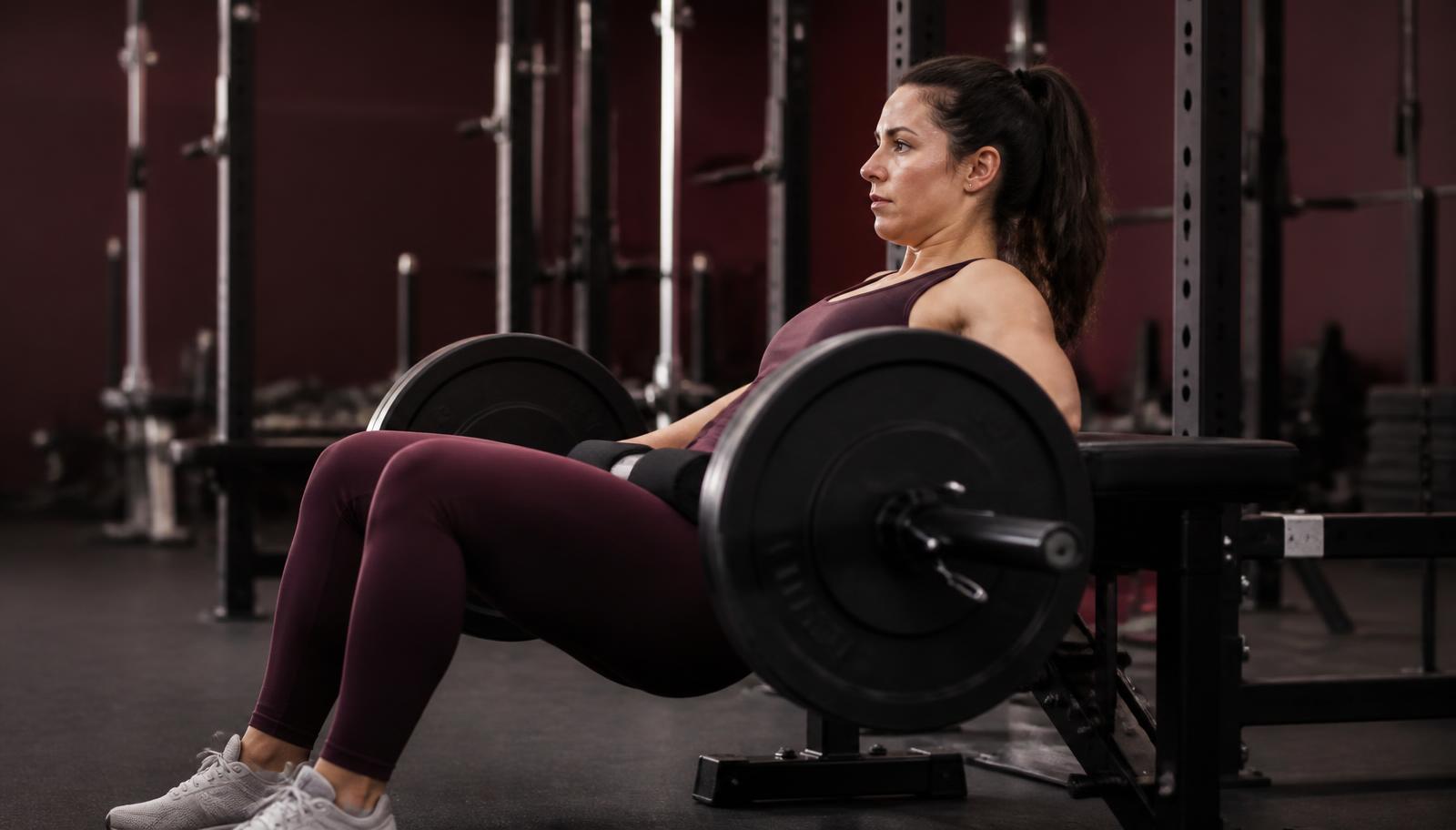
The barbell hip thrust has legitimate research behind it.
A randomized training study compared hip thrusts with back squats over nine weeks and used MRI to measure actual muscle growth. [2]
Both groups experienced similar glute growth.
That’s important because social media loves declaring exercises either:
THE BEST EXERCISE EVER CREATED
or
ABSOLUTELY USELESS.
Reality is considerably less dramatic.
The 2025 systematic review concluded that barbell hip thrusts can be particularly useful when the goal is emphasizing the gluteus maximus, while combinations of single-joint and multi-joint hip-extension exercises can also effectively promote growth. [1]
So instead of asking:
“Should I squat OR hip thrust?”
A better question may be:
“How can both fit intelligently into my program?”
🍑 Mystery #4: Deadlifts Aren’t Useless Either
The deadlift sometimes gets treated like the ugly cousin at the booty-building family reunion.
But deadlift variations can strongly recruit the gluteus maximus.
A systematic review examining glute activation found high levels during exercises including conventional deadlifts, hex-bar deadlifts, hip thrusts, lunges, split squats and step-up variations. [6]
But here’s an important distinction:
Muscle activation ≠ guaranteed muscle growth.
An EMG study can tell us about electrical activity recorded from a muscle during an exercise.
It does not automatically tell us which exercise will produce the largest butt six months later.
In fact, the squat-versus-hip-thrust training study found substantially greater glute EMG during the hip thrust in the initial testing session, yet both training groups subsequently experienced similar glute hypertrophy. [2]
That’s exactly why long-term training studies that actually measure changes in muscle size are so valuable.
So when somebody posts:
“SCIENTISTS DISCOVER THE #1 GLUTE EXERCISE!!! 😱🍑”
because one exercise produced a big EMG reading…
Keep scrolling.
Your ass deserves better research methodology.
🍑 Mystery #5: You’re Majoring in Donkey Kicks and Minoring in Heavy Stuff
Donkey kicks aren’t inherently bad.
Neither are cable kickbacks, bands or other accessory movements.
In fact, kneeling hip-extension exercises have evidence supporting their ability to contribute to glute growth. [1]
But there’s a difference between including these exercises and building your entire program around them.
Think of your booty workout like Thanksgiving dinner.
Squats, hip thrusts, lunges, step-ups and other progressively loaded movements are the turkey, dressing and macaroni.
Kickbacks are the cranberry sauce.
Wonderful addition.
But we’re not serving eight bowls of cranberry sauce and calling that Thanksgiving.
🍑 Mystery #6: You Keep Changing Your Workout Every 11 Minutes
Monday:
Hip thrusts.
Wednesday:
You watched TikTok.
Now we’re doing Bulgarian split squats.
Friday:
Instagram said sumo squats are superior.
Next Monday:
Some man wearing a microphone in LA told you squats don’t build glutes.
STOP.
Muscle growth requires repeated training over time.
Your program doesn’t need to be boring forever, but constantly replacing exercises makes it harder to track whether you’re actually progressing.
Choose movements you can perform safely and effectively.
Learn them.
Track them.
Progress them.
Then modify the program when there is a reason to modify it.
Muscle likes consistency considerably more than the algorithm does.
🍑 Mystery #7: You May Not Be Training Enough—or Recovering Enough
Your glutes don’t know that Monday has been declared “International Leg Day.”
They respond to training stimulus and recovery.
Here’s where fitness advice often gets oversimplified.
Research suggests that when weekly training volume is equated, simply increasing the number of days you train a muscle does not necessarily produce greater hypertrophy. [7]
That means there isn’t one magical weekly glute frequency that everybody has to follow.
Practically, however, distributing your training across the week can make it easier to accumulate quality work without trying to perform your entire booty-building career on Monday night.
For many people, two or three intelligently programmed lower-body sessions may be practical—but the appropriate schedule depends on training volume, experience, recovery and the rest of the program.
Recovery matters too.
Muscles aren’t literally growing while you’re performing the set.
Training provides the stimulus.
Then your body needs adequate nutrition, sleep and recovery to adapt to it.
More is not automatically better.
Your ass does occasionally need a day off.
🍗 Mystery #8: Baby… Are We Eating?
This part gets conveniently forgotten.
You cannot discuss hypertrophy without discussing nutrition.
Resistance training stimulates muscle growth, but your body still needs adequate energy and protein to build and maintain tissue.
A major meta-analysis found that protein supplementation enhanced gains in muscle mass and strength during prolonged resistance training. In that analysis, additional benefits to fat-free-mass gains appeared to level off around a total protein intake of approximately 1.6 grams per kilogram of body weight per day. [8]
That does not mean everybody needs exactly 1.6 g/kg.
That’s a research finding—not a personalized prescription.
Individual nutritional needs vary based on body size, goals, total energy intake, health status, training demands and other factors.
And protein powder isn’t magic butt dust.
- Chicken works.
- Fish works.
- Eggs work.
- Dairy works.
- Soy works.
- Beans and legumes work.
- Other plant proteins work.
Protein powder is simply convenient.
You cannot out-squat chronic under-fueling.
🧬 Mystery #9: Genetics Entered the Chat
Here comes the part nobody can sell you.
Your natural butt shape is partly influenced by biology you didn’t choose.
Your pelvis, skeletal structure, muscle architecture and attachment points, fat distribution and genetics all influence how your body looks.
Two people can follow similar programs and develop different-looking glutes.
One may develop a very round appearance.
Another may become significantly stronger and more muscular but retain a different shape.
Training can increase muscle size.
Training can change proportions.
Training can improve strength.
But training cannot redesign your skeleton.
So stop comparing your Week 12 butt to somebody else’s genetically blessed, perfectly posed, professionally lit, freshly pumped Instagram butt.
That is not a controlled clinical trial.
🍑 So What Should I Actually Do?
If glute hypertrophy is the goal, build your program around multiple useful movement patterns rather than searching for one magical exercise.
A practical glute-focused program might include:
1. A Squat/Lunge Pattern
Examples:
- Back squat
- Front squat
- Bulgarian split squat
- Reverse lunge
- Leg press
These challenge the glutes alongside the quadriceps and other lower-body musculature.
2. A Hip-Thrust/Bridge Pattern
- Barbell hip thrust
- Machine hip thrust
- Glute bridge
These allow substantial loading of hip extension and can effectively train the gluteus maximus.
3. A Hinge Pattern
- Romanian deadlift
- Conventional deadlift
- Trap-bar deadlift
These train hip extension while involving the hamstrings and other posterior-chain musculature.
4. Unilateral Movements
- Step-ups
- Split squats
- Single-leg variations
Besides loading the glutes, unilateral exercises challenge stability and train each side independently.
5. Abduction/Accessory Work
- Hip abduction machine
- Cable abduction
- Cable kickbacks
- Kneeling hip extensions
And yes, you may use the machine where you sit down and open your legs while staring aggressively at everyone walking past.
We all know the machine.
📈 The Part Nobody Wants to Do: Track Your Training
You track your money.
You track packages.
You track your DoorDash driver like they’re transporting a donated kidney.
Track your workouts.
Write down:
- Exercise
- Weight or resistance
- Sets
- Repetitions
Then look for improvement over weeks and months.
For example:
- Week 1: Hip thrust — 135 × 10
- Week 4: Hip thrust — 155 × 10
- Week 8: Hip thrust — 185 × 8
THAT tells us something.
“I did booty day really hard today” does not.
🚨 And Please Stop Falling for These
“This exercise targets your upper booty fat.”
Muscle and fat are different tissues.
Exercises can train particular muscles, but you cannot command your body to remove fat from one tiny location simply by exercising the muscle underneath it.
“Do 100 squats every day for a bigger butt.”
A high repetition count isn’t automatically an effective hypertrophy program.
The body responds to the training stimulus, not your ability to count to 100 while questioning your life choices.
“You have to lift extremely heavy to grow.”
Not necessarily.
Research shows muscle hypertrophy can occur across different resistance-training prescriptions, while heavier loads tend to have clearer advantages for maximizing strength. [4]
The 2026 ACSM position stand likewise emphasizes that resistance-training variables should be manipulated according to the adaptation being pursued rather than assuming one loading strategy is universally superior. [5]
“If you don’t feel your glutes burning, they aren’t growing.”
No.
The burn is not a certified letter from your gluteus maximus confirming hypertrophy.
“Women should train differently from men to get a feminine butt.”
Human muscle physiology did not subscribe to that YouTube channel.
Programming should primarily reflect the person’s goals, abilities, training history, anatomy and preferences—not social-media stereotypes.
🍑 The Anal Coach’s Bottom Line
Your butt isn’t necessarily flat because you haven’t discovered the secret exercise.
You may simply need a better training strategy.
For building the glutes, current evidence supports progressively challenging resistance training using movements such as squats, hip thrusts and other hip-extension exercises. A combination of movements can work extremely well. [1]
- Train consistently.
- Use enough resistance to make your training appropriately challenging.
- Use an appropriate range of motion.
- Progress over time.
- Eat adequately.
- Get enough protein.
- Recover.
- And give it time.
Because despite what social media promises…
You cannot Amazon Prime a booty.
Muscle takes time to build.
But if you’ve been faithfully doing 700 unweighted donkey kicks every night since February and wondering why nothing has happened?
We may have solved…
🍑 THE MYSTERY OF THE FLAT BEHIND.
When to Seek Medical Care
Exercise carries a risk of injury, and training through the wrong kind of pain rarely ends well. Check in with a healthcare professional or a qualified exercise professional if you notice:
- Sharp, sudden or radiating pain during or after training
- Pain, numbness or tingling travelling down the leg
- Hip, low back or pelvic pain that does not settle with rest
- Pain with sitting, bowel movements or pelvic floor symptoms
- New rectal bleeding, a lump or persistent anal pain — that is not a training issue
- Any concern about whether exercise is appropriate for you during pregnancy, postpartum, after surgery or with an existing medical condition
Soreness that fades in a couple of days is normal. Pain that changes how you walk, sit or sleep is worth a professional opinion.
Frequently Asked Questions
References & Evidence
- 1.Krause Neto W, Krause TLV, Gama EF. The impact of resistance training on gluteus maximus hypertrophy: a systematic review and meta-analysis. Frontiers in Physiology. 2025. PMID: 40276368. View on PubMed doi:10.3389/fphys.2025.1542334
- 2.Plotkin DL, et al. Hip thrust and back squat training elicit similar gluteus muscle hypertrophy and transfer similarly to the deadlift. Medicine & Science in Sports & Exercise. 2023. PMID: 37877099. View on PubMed
- 3.Kassiano W, Costa B, Nunes JP, Ribeiro AS, Schoenfeld BJ, Cyrino ES. Which ROMs Lead to Rome? A Systematic Review of the Effects of Range of Motion on Muscle Hypertrophy. Journal of Strength and Conditioning Research. 2023;37(5):1135–1144. PMID: 36662126. View on PubMed doi:10.1519/JSC.0000000000004415
- 4.Currier BS, et al. Resistance training prescription for muscle strength and hypertrophy in healthy adults: a systematic review and Bayesian network meta-analysis. British Journal of Sports Medicine. 2023;57(18):1211–1220. PMID: 37414459. View on PubMed doi:10.1136/bjsports-2023-106807
- 5.Currier BS, et al. American College of Sports Medicine Position Stand. Resistance Training Prescription for Muscle Function, Hypertrophy, and Physical Performance in Healthy Adults: An Overview of Reviews. Medicine & Science in Sports & Exercise. 2026;58(4):851–872. PMID: 41843416. View on PubMed doi:10.1249/MSS.0000000000003897
- 6.Krause Neto W, et al. Gluteus Maximus Activation during Common Strength and Hypertrophy Exercises: A Systematic Review. Journal of Sports Science & Medicine. 2020;19(1):195–203. PMID: 32132843. View on PubMed
- 7.Schoenfeld BJ, Grgic J, Krieger J. How many times per week should a muscle be trained to maximize muscle hypertrophy? A systematic review and meta-analysis of studies examining the effects of resistance training frequency. Journal of Sports Sciences. 2019;37(11):1286–1295. PMID: 30558493. View on PubMed doi:10.1080/02640414.2018.1555906
- 8.Morton RW, et al. A systematic review, meta-analysis and meta-regression of the effect of protein supplementation on resistance training-induced gains in muscle mass and strength in healthy adults. British Journal of Sports Medicine. 2018;52(6):376–384. PMID: 28698222. View on PubMed doi:10.1136/bjsports-2017-097608
Bracketed numbers in the article correspond to the sources above.