On this page
- The Bottom Line
- Key Facts
- What Did You Eat?
- Corn: The Great Digestive Misunderstanding
- Coffee: The Morning Meeting Nobody Scheduled
- Spicy Food: Burning Twice Is Not a Myth
- Sugar-Free Candy & Gum
- Bananas: It Depends on the Banana
- Meat: Myth vs. Reality
- Steak: Plate A vs. Plate B
- Grandma Called It Roughage
- The Seven-Year Gum Question
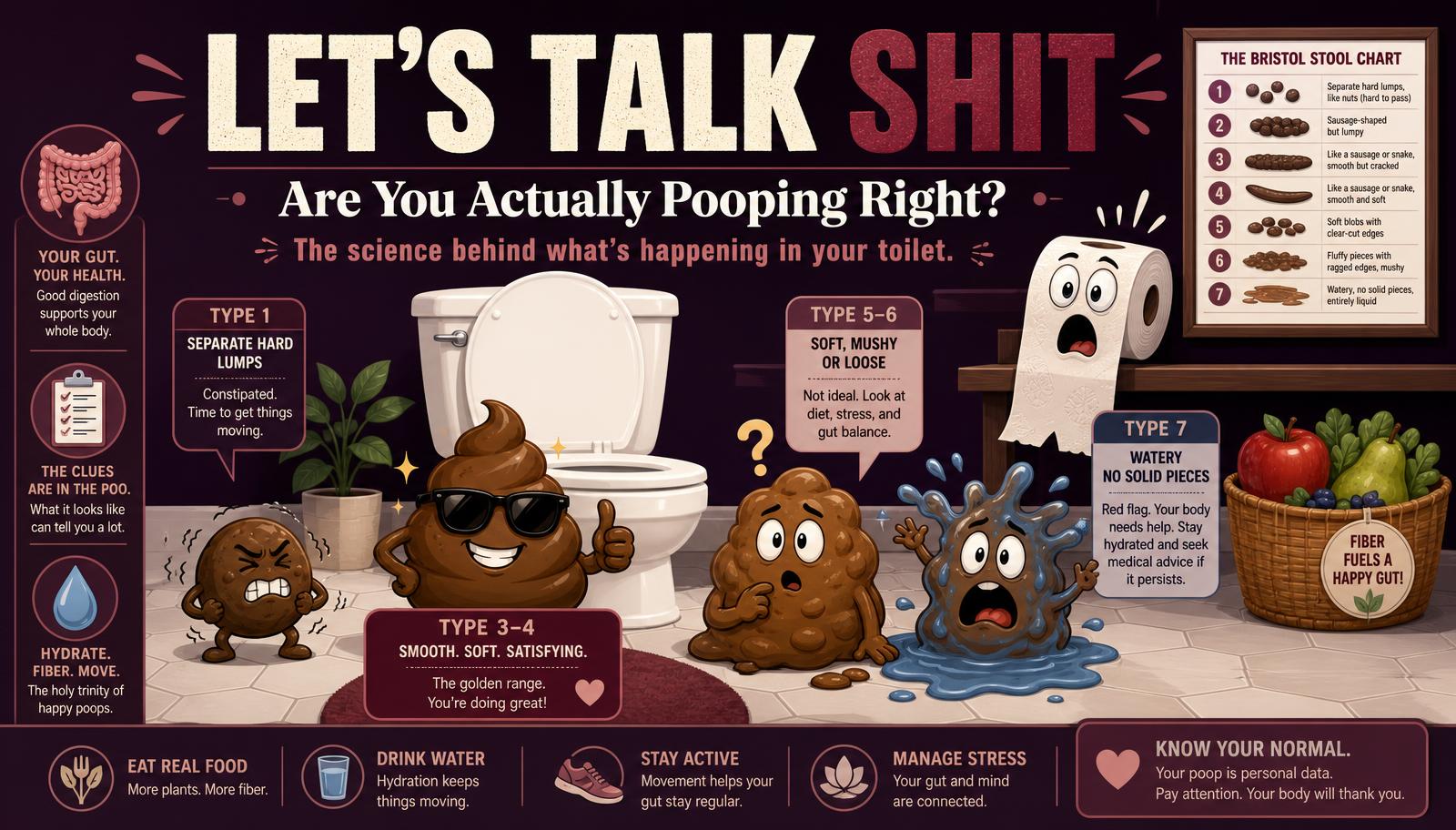
- Reading What Comes Out: The Bristol Stool Form Scale
- Did Grandma Lie?
- Build a Poop-Friendlier Plate
- When to Seek Medical Care
- Research & references
The Bottom Line
Everybody has a theory about their own digestion. Cheese blocks you up. Coffee is a scheduled appointment. Corn doesn't get digested at all. Steak sits in your colon for three days like an unpaid parking ticket.
Some of that is true. Some of it is folklore your family has been passing down like a casserole dish. And a surprising amount of it falls somewhere in between, which is the least satisfying answer and usually the correct one.
Food genuinely does change stool — its form, its frequency, how much gas comes with it and how comfortable the whole event is. It just doesn't do it the way most people think, and it doesn't do it identically in everybody.
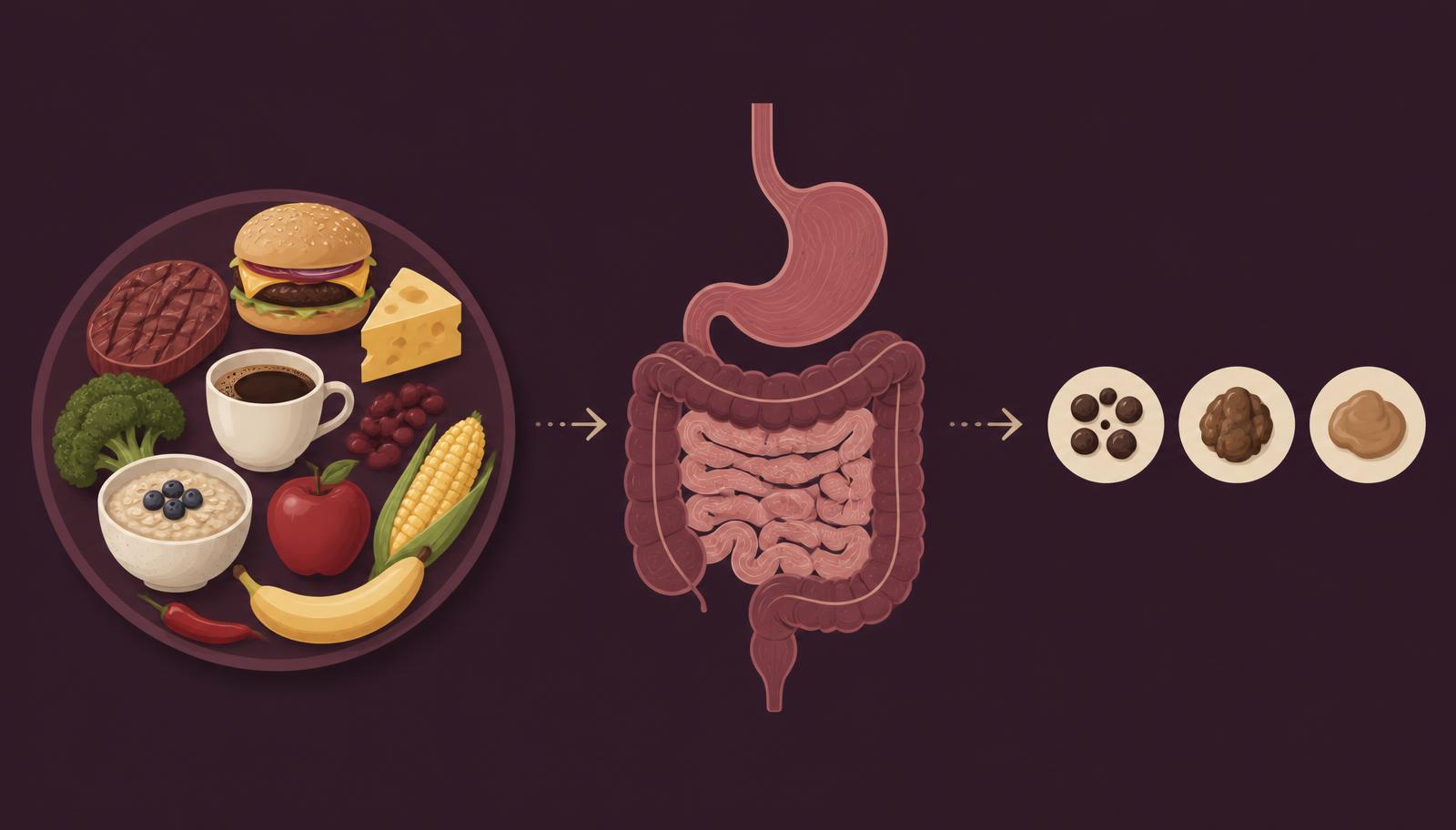
The key is understanding what food actually becomes after you swallow it.
The journey
From food to stool
Mouth / Stomach
Food is mechanically and chemically broken down.
Small intestine
Most nutrients are digested and absorbed.
Colon
Water and electrolytes are absorbed. Gut bacteria ferment some remaining carbohydrates and fibers.
Rectum
Stool is stored until defecation.
Your last meal does not simply become your next poop. What you pass today reflects days of eating, drinking, moving and living — not just dinner.
Key Facts
- Stool is shaped by fiber, fluid, transit time, gut bacteria, medications and individual physiology — not just your last meal.
- Fat-rich meals generally empty from the stomach more slowly than lower-fat meals.
- Fermentable carbohydrates and fiber can increase intestinal gas — that is normal chemistry, not damage.
- Coffee can stimulate colonic activity in some people, but not in everyone.
- Meat is digested and absorbed in the small intestine; it does not normally sit in the colon and rot.
- Sugar alcohols in sugar-free candy and gum can cause gas, bloating and diarrhea in some people.
- Adults are generally advised to get roughly 22–34 g of fiber per day, depending on age and sex.
These are general educational patterns. Food does not produce identical stool responses in everyone.
What Did You Eat?
Below is the practical part: a food-by-food guide to what commonly happens downstream, why it happens, and how much of it is actually about the food versus everything else on the plate.
Interactive guide
What did you eat?
Tap a food to see what it might do downstream.
Individual responses vary. These indicators describe common digestive effects, not guaranteed outcomes.
Corn: The Great Digestive Misunderstanding
No food has damaged public confidence in the human digestive system quite like corn. People see recognizable kernels and conclude their body simply gave up.
Cutaway diagram
Inside a corn kernel
Before digestion
A whole kernel: a starchy, nutrient-dense interior wrapped in a tough outer hull.
Digestible interior
Starch, protein and fat inside the kernel are broken down and absorbed.
Fibrous outer shell
The cellulose hull resists human digestive enzymes and can stay recognizable.
You digested the corn. You just couldn’t completely destroy the packaging.
Chewing helps. So does the reassurance that seeing corn is not a sign that anything is wrong with you.
Coffee: The Morning Meeting Nobody Scheduled
For a lot of people, coffee is less a beverage and more a bathroom alarm clock. Research supports that this is real — for some people.
Mechanism
The coffee → colon connection
Coffee
Gastrointestinal tract
Colonic motor activity
Urge to go — in some people
Coffee can stimulate colonic motor activity in some people. It does not do this for everyone, and it is not a treatment for constipation.
In research measuring colonic activity, responses have been observed in some participants within minutes of drinking coffee.
What we cannot say is that coffee makes everyone poop, or that it should be used as a constipation treatment. If your body responds, that's useful information about your body, not a universal rule.
Spicy Food: Burning Twice Is Not a Myth
Capsaicin does not stop being active once you've swallowed it, and the receptors it acts on are not confined to your tongue.
Capsaicin
Why spicy food can burn twice
🌶️ Capsaicin
The active compound in chili peppers.
Mouth sensory receptors
Heat-sensing receptors register a burning sensation.
Gastrointestinal tract
Similar receptors are present further down, and transit may speed up.
Anal sensory nerves
The same kind of receptors are present at the exit.
“Your mouth was not the only department copied on that email.”
Sugar-Free Candy & Gum
Of everything in this article, this is the category most likely to ruin somebody's afternoon without warning.
Sugar alcohols
Sugar-free doesn't mean consequence-free
Sorbitol · Mannitol · Maltitol · Xylitol
Common sugar alcohols in sugar-free candy, gum and mints.
Incomplete absorption in some people
Not fully absorbed in the small intestine.
More material reaches the colon
Water is drawn in + bacterial fermentation
Gas · Bloating · Loose stool · Diarrhea
Regret.
The reaction is dose-dependent and varies between people. Four mints is a different conversation than half a bag.
Bananas: It Depends on the Banana
Bananas have somehow been recruited as evidence for both constipation and diarrhea, which should tell you something.
Ripeness
One banana, three different carbohydrate profiles
Less ripe
More resistant starch, fewer simple sugars.
Ripe
Starch is converting toward simpler sugars.
Very ripe
More simple sugars, less resistant starch.
More resistant starch ←→ more simple sugars
Carbohydrate composition changes as a banana ripens, which is part of why people report such different experiences with them. Bananas don’t automatically cause or cure constipation.
Meat: Myth vs. Reality
The claim that meat sits in your colon for days is one of the most durable pieces of digestive misinformation on the internet. Here is what actually happens.
Myth vs. reality
Does red meat sit in your stomach for three days?
Myth
“Red meat sits in your stomach for three days.”
❌ False
Reality
🥩 Meat
Stomach
Mechanical and chemical breakdown begins.
Small intestine
Protein → peptides and amino acids. Fat → fatty acids and other digestion products.
Nutrients absorbed
Meat does not normally sit intact in your colon and “rot.”
Digestion
What actually changes digestion?
Meal size
Larger meals behave differently than small ones.
Fat content
Fat-rich meals generally empty from the stomach more slowly than lower-fat meals.
Fiber
Fiber influences stool bulk, water content and transit.
Preparation method
How food is cooked and processed changes how it is handled.
Other foods in the meal
Nothing is digested in isolation.
Individual physiology
Transit time, microbiome and medical conditions differ between people.
You’ll find charts online claiming beef takes exactly 72 hours and fish takes exactly 30 minutes. Those numbers are invented. Digestion is a range, not a train timetable.
Steak: Plate A vs. Plate B
Two people eat the same ribeye on the same night and have two completely different mornings. The steak isn't the variable. The rest of the plate is.
Same steak, different night
Plate A vs. Plate B
Plate A — lower-fiber meal
- 🥩 Ribeye
- 🧀 Mac & cheese
- 🥖 White roll
- 🍰 Cheesecake
Plate B — more fiber + fluid
- 🥩 Ribeye
- 🥦 Broccoli
- 🫘 Lentils
- 🌾 Whole grain
- 🍎 Fruit
- 💧 Water
The question isn’t just “did you eat steak?” It’s “what did you eat with the steak?”
“Sir, you didn’t feed your colon dinner. You submitted building materials for a brick.”
Grandma Called It Roughage
She was not wrong. She just didn't have the vocabulary — or the patience to explain that there are two broad categories of dietary fiber doing two different jobs.
Grandma called it roughage
We call it dietary fiber
Soluble fiber
Interacts with water and forms a gel-like consistency.
Found in: oats, beans, psyllium, certain fruits
Helps hold water and can contribute to softer, well-formed stool.
Insoluble fiber
Passes through largely intact and adds plant material to stool.
Found in: wheat bran, vegetables, whole grains, fruit skins
Adds bulk and can support intestinal movement.
Most fiber-containing foods deliver a mix of both, which is one more reason variety beats supplements for most people.
Daily fiber
Are you getting enough fiber?
22–34 g
Approximate daily fiber intake recommended for adults, depending on age and sex.
~14 g
General dietary guideline: about 14 grams of fiber per 1,000 calories.
Foods that contribute toward fiber intake:
- 🫘 Beans & lentils
- 🥣 Oats
- 🌾 Whole grains
- 🥦 Vegetables
- 🍎 Fruit with skin
- 🌰 Nuts & seeds
- 🍿 Popcorn
Don’t forget the water.
Fiber + fluid → softer, bulkier stool that is generally easier to pass.
Rapid fiber increase + inadequate fluid → a potentially uncomfortable bathroom situation.
Water is not a treatment for all constipation, and fiber is not right for every medical condition. Ramp up gradually and talk to a clinician if symptoms persist.
The Seven-Year Gum Question
Myth check
Does gum stay in your stomach for seven years?
No.
- Gum
- Stomach
- Small intestine
- Colon
- 🚽
Your body may not completely digest gum base, but your gastrointestinal tract can still move it along.
Your stomach is not a lost-and-found box.
Worth saying clearly: repeatedly swallowing large quantities of gum is not recommended, and rare intestinal blockages have occurred, particularly in children.
Reading What Comes Out: The Bristol Stool Form Scale
Clinicians describe stool using the Bristol Stool Form Scale, which sorts stool into seven forms from hard separate lumps to entirely liquid. Types 3 and 4 are generally described as the well-formed sweet spot. Types 1 and 2 suggest harder, slower transit; types 6 and 7 suggest looser, faster transit.
💩 Meet your boo-boo
Tap the poop that looks most like yours. No judgment. We've seen shit.
One unusual day is a data point, not a diagnosis. What matters is your own pattern and whether it has meaningfully changed.
Everything counts
Your poop is a receipt
The Anal Coach
Itemized digestive statement
- Food
- Fiber
- Hydration
- Medications
- Physical activity
- Stress
- Hormones
- Gut microbiome
- Medical conditions
- Individual bowel pattern
TotalYour bowel movement
One poop doesn’t tell the whole story. Patterns matter.
Did Grandma Lie?
A quick verdict round on the digestive wisdom you inherited.
Myth carousel
Did Grandma lie?
“Gum stays in your stomach for seven years.”
❌ Myth
Gum base may not be fully digested, but the gastrointestinal tract can still move it along like other indigestible material.
“You need roughage.”
✅ Mostly true
Fiber is an important part of most people's diets, although individual medical conditions can change fiber needs.
“Meat rots in your colon.”
❌ Myth
Protein and fat are broken down and absorbed in the small intestine. Meat does not normally sit intact in the colon.
“Coffee makes you poop.”
🟡 Sometimes
Coffee can stimulate colonic activity in some people, but not in everyone.
“Corn isn't digested.”
🟡 Not exactly
Much of the kernel is digested, while portions of the fibrous exterior can remain recognizable.
“Cheese plugs you up.”
🟡 It depends
Cheese contains essentially no fiber, but overall dietary pattern matters more than blaming one food.
“Beans make you fart.”
✅ They certainly can
Fermentable carbohydrates and fiber can increase intestinal gas.
“Spicy food can burn twice.”
🟡 For some people
Capsaicin can contribute to GI symptoms and anal burning in susceptible people.
Swipe to see more →
Build a Poop-Friendlier Plate
Final takeaway
Build a poop-friendlier plate
- Plants / fiber
- Adequate fluid
- Movement
- Dietary variety
- Regular habits
= Better odds of comfortable, regular bowel movements.
Your colon doesn’t need a detox. It needs you to feed it like you actually own one.
When to Seek Medical Care
🚩 When it's more than your dinner. Some symptoms are not a food reaction and should be evaluated by a clinician:
- Rectal bleeding
- Blood in the stool
- Persistent abdominal pain
- Inability to pass gas
- Vomiting
- Fever
- Unexplained weight loss
- Persistent, unexplained changes in bowel habits
These symptoms deserve medical evaluation—not another bowl of Raisin Bran.
Frequently Asked Questions
Scholarly Sources & References
- 1.National Institute of Diabetes and Digestive and Kidney Diseases (NIDDK). Your Digestive System & How It Works. Read at NIDDK
- 2.National Institute of Diabetes and Digestive and Kidney Diseases (NIDDK). Symptoms & Causes of Constipation. Read at NIDDK
- 3.National Institute of Diabetes and Digestive and Kidney Diseases (NIDDK). Lactose Intolerance. Read at NIDDK
- 4.National Institute of Diabetes and Digestive and Kidney Diseases (NIDDK). Gas in the Digestive Tract. Read at NIDDK
- 5.Rao SS, Welcher K, Zimmerman B, Stumbo P. Is coffee a colonic stimulant? European Journal of Gastroenterology & Hepatology. 1998;10(2):113–118. PMID: 9581985. View on PubMed
- 6.Brown SR, Cann PA, Read NW. Effect of coffee on distal colon function. Gut. 1990;31(4):450–453. PMID: 2338272. View on PubMed
- 7.Lewis SJ, Heaton KW. Stool form scale as a useful guide to intestinal transit time. Scandinavian Journal of Gastroenterology. 1997;32(9):920–924. PMID: 9299672. View on PubMed
- 8.U.S. Department of Agriculture and U.S. Department of Health and Human Services. Dietary Guidelines for Americans, 2020–2025. Read the Dietary Guidelines
- 9.Milov DE, Andres JM, Erhart NA, Bailey DJ. Chewing gum bezoars of the gastrointestinal tract. Pediatrics. 1998;102(2):e22. PMID: 9685468. View on PubMed
- 10.Gonlachanvit S, Mahayosnond A, Kullavanijaya P. Effects of chili on postprandial gastrointestinal symptoms in diarrhoea predominant irritable bowel syndrome. Alimentary Pharmacology & Therapeutics. 2009;30(4):386–392. PMID: 19416131. View on PubMed
- 11.Mäkinen KK. Gastrointestinal disturbances associated with the consumption of sugar alcohols. International Journal of Dentistry. 2016;2016:5967907. PMID: 27840639. View on PubMed